
Daviess County Court Records After Arrest
The arrest-to-court path in Daviess County starts with booking at the Daviess County Security Center, operated by Sheriff Gary Allison's office. The jail creates the intake record, holds property, records the arrest or commitment authority, and begins custody processing. The court record begins when the prosecutor files the charges or the case is otherwise opened in court. Daviess County Prosecutor Abby Brown's office handles criminal charges, and the Daviess County Clerk is the record keeper for county-level court cases.
Jail custody and court records after an arrest answer different questions. Current custody belongs with VINE/SAVIN, the Detention Center, and Daviess County jail inmate records. Booking photos and photo-release issues belong with Daviess County jail mugshots. IDOC is used after a state-prison transfer, while the BOP locator and ICE ODLS handle federal and immigration custody. The court case shows prosecutor-filed charges, cause numbers, court dates, bond orders, warrants, dismissed or amended counts, disposition, and sentence when those records are public.
Find Daviess County Court Records
The main statewide public case tool is Indiana MyCase. The Indiana Judicial Branch Daviess County page links users to MyCase, e-filing, local rules, and court statistics. The state public-records page says some court case information and documents are free through MyCase. If a filing is not online, the clerk in the county where the case is heard is the fallback.
- Open MyCase and search by defendant name, case number, citation number, attorney, or other available field.
- Narrow results to Daviess County when the filter is available, especially for common names.
- Open the criminal or traffic case and read the charge list, cause number, court, and event history.
- Compare each charge status with the jail booking charge, since prosecutor-filed charges may be amended or dismissed.
- Contact the Daviess County Clerk if a public document exists but is not available in the online view.
The official Indiana Judicial Branch public records page is the statewide reference for court-record access and clerk fallback. It should be used for court documents, not for jail custody status.
The Indiana MyCase portal is the official public search point for Daviess County court records after jail arrest when a case has been filed.
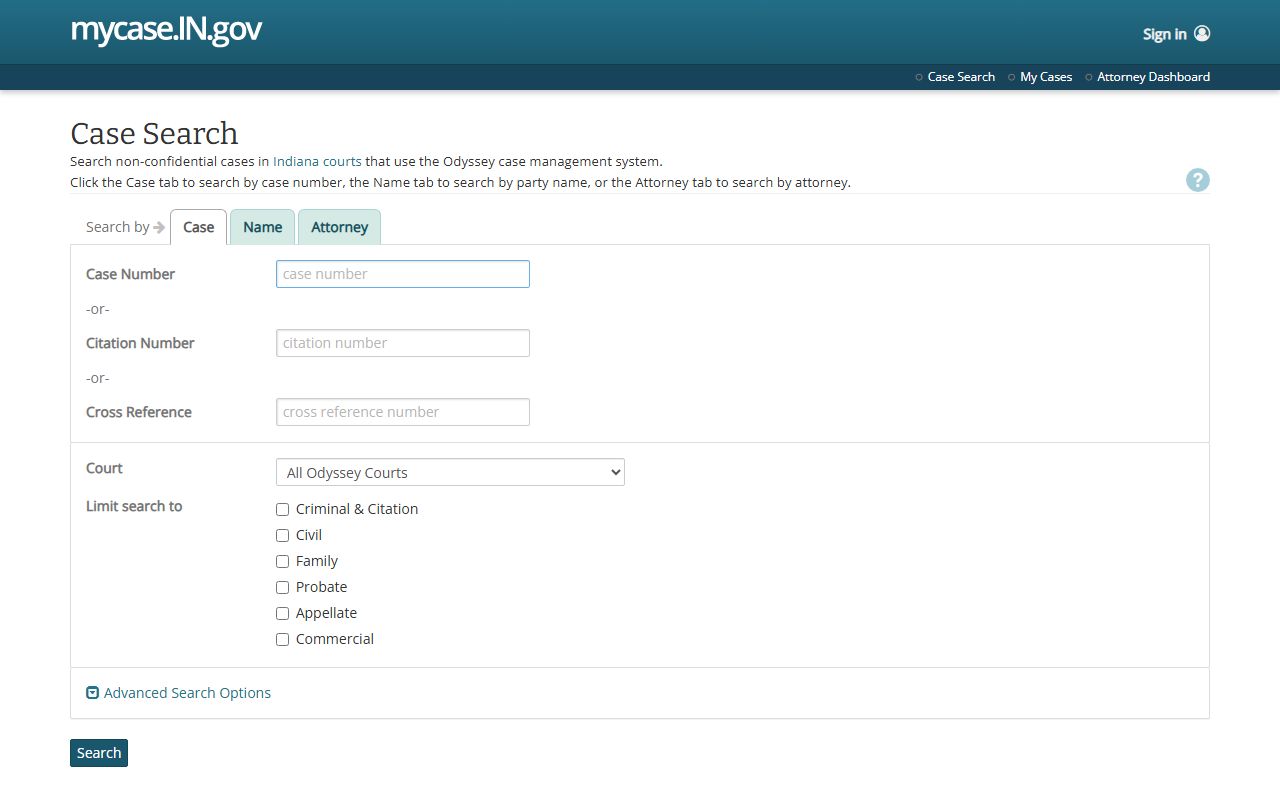
Daviess County Court Search Fields
MyCase is a statewide system, so Daviess County court records after an arrest may appear beside cases from other Indiana counties. Use more than one field when possible. A cause number is the cleanest search key, but many users start with the defendant name and then confirm county, court, birth year if shown, and event history.
| Field Label | Type | Required | Notes |
|---|---|---|---|
| Case Number | Text | Optional by mode | Best when a Daviess cause number is known. |
| Name | Text | Optional by mode | Search defendant name; try aliases or spelling variants. |
| Business Name | Text | Optional | Usually not relevant for a jail arrest case. |
| Attorney | Text | Optional | Can locate cases by counsel of record. |
| Citation Number | Text | Optional | Useful for traffic and misdemeanor citation matters. |
| Court or County | Dropdown/filter | Optional | Select Daviess when available to narrow statewide results. |
| Case Type | Dropdown/filter | Optional | Criminal, infraction, ordinance, and related case types may appear. |
Charges After Daviess County Arrest
Booking charges are not always the final court charges. The arresting officer may list a suspected offense at intake, but the prosecutor decides what to file. A charge can be added, reduced, amended, or dismissed after review. In Daviess County court records after jail arrest, the formal charging document is the key record because it starts or defines the court case.
| Charging Document | Who Uses It | What It Does | What to Check |
|---|---|---|---|
| Complaint | Officer or prosecutor | States the factual basis or alleged offense that begins a case. | Offense level, probable-cause facts, filing date. |
| Information | Prosecutor | Formally files charges without a grand jury indictment. | Count numbers, code sections, amended filings. |
| Indictment | Grand jury | Charges an offense after grand jury action. | Filed counts, court assignment, bond or warrant events. |
The prosecutor's office is at 200 E Walnut Street in Washington and lists phone 812-254-8673 with weekday office hours. That office prosecutes the criminal case. The clerk maintains the court record and is the records fallback when MyCase does not display a document.
Daviess County Charge Status
Charge status is where court records after a jail arrest become more reliable than a booking entry. A booking charge may explain why a person entered jail, but the court status explains where the filed case stands. The same case may include pending counts, dismissed counts, amended charges, plea entries, trial settings, warrants, and final disposition.
| Status | What It Means | Why It Matters |
|---|---|---|
| Pending | The charge is active and has not reached final disposition. | Court dates, bond, and release terms may still change. |
| Amended | The prosecutor or court changed the filed charge. | The booking charge may no longer match the current charge. |
| Reduced | The charge level or offense was lowered. | Sentencing range and case outcome may change. |
| Dismissed | The charge was dropped by court order or prosecution action. | A dismissal is not the same as an expungement. |
| Disposed | The case or count reached an outcome. | Read the disposition, plea, conviction, acquittal, or sentence entry. |
Daviess County Bond Records
Daviess County publishes local bonding procedures. Bond can be own recognizance, full cash, 10% cash, or credit card through JailATM or the lobby machine. The Security Center bonds people out at all hours, but the county tells users to contact the booking officer before paying online or in the lobby. Some violent crimes require a wait before bond, and intoxication can also delay release.
| Bond Type | How It Works in Daviess County |
|---|---|
| Own recognizance | A judge releases the person on a promise to appear, by court order only. |
| Cash bond | The full bond is posted in cash and may be returned after the case, subject to costs and court orders. |
| 10% cash bond | Ten percent is posted and may be returned after deductions for fines, fees, costs, or other court-ordered amounts. |
| Credit card bond | May be paid through JailATM or the Security Center lobby machine. |
| No-bond or hold | A court order, warrant, DOC hold, federal hold, ICE detainer, or another agency hold may block release. |
Initial arraignment hearings are held at the Daviess County Courthouse on Mondays at 10:00 a.m. and Thursdays at 8:30 a.m., subject to holidays and weather. Bond can change at that first court event, so MyCase and court orders should be checked after the hearing.
Daviess County Arrest Warrants
No official online active warrant search page was found in the inspected Daviess County sources. The staff directory lists warrant-related contacts at 812-254-1060, and the Sheriff's report and permit information page says the office provides warrant searches as a local public-record service. The Clerk's Office issues warrants and keeps county-level court records, so a warrant may appear in the court case history when public.
Tax warrant letters should not be treated as arrest warrants. Daviess County states that tax warrant letters are collection notices tied to Indiana Department of Revenue liability. Questions about those tax matters go to the state revenue contact, not to a criminal court warrant search. Criminal warrants, bench warrants, failure-to-appear warrants, and agency holds can lead to booking at the Security Center.
Daviess County Charges vs Convictions
An arrest or charge is an allegation. A conviction is a court outcome after a plea or finding of guilt. Daviess County court records after an arrest should be read by count and by status, because one case can contain several charges with different outcomes. A dismissed charge may remain visible until sealed or expunged under Indiana law.
| Issue | Charge | Conviction |
|---|---|---|
| Stage | Accusation filed in court. | Final outcome after plea, trial, or judgment. |
| Proof level | Based on probable cause or charging review. | Requires a guilty plea or proof beyond a reasonable doubt. |
| Record meaning | Shows what was alleged. | Shows legal responsibility and sentence when imposed. |
| Can change | May be amended, reduced, or dismissed. | May be appealed, modified, or later affected by expungement law. |
Sealed and Expunged Arrest Records
Indiana Code chapter 35-38-9 controls many sealing and expungement issues for arrest and criminal records. The practical point is simple: a dismissal or completed sentence does not automatically erase every public record in every system. A person may need a court order before a public court record, booking photo, or arrest record is restricted from public access.
| Issue | Sealed | Expunged |
|---|---|---|
| Public view | Hidden or restricted from ordinary public access. | Restricted under the expungement order and statute. |
| Underlying record | May still exist for limited authorized use. | May still be available to courts or agencies as law allows. |
| Eligibility | Depends on the case result, offense, waiting period, and statute. | Depends on Indiana Code 35-38-9 and court order. |
| Effect on jail photo | May support removal or withholding from public release. | May require agencies to restrict public disclosure. |
Record access note: Indiana APRA favors public access, but IC 5-14-3-4 allows or requires withholding for some confidential, investigatory, juvenile, sealed, or protected records.